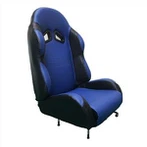
Older forklifts are still widely used in warehouses, factories, farms, workshops, and rental fleets. Many of these machines continue to perform well mechanically, but the operator seat is often in poor condition.
A worn forklift seat may have:
- cracked vinyl
- collapsed foam
- broken slide rails
- loose mounting points
- damaged seat belts
- missing or failed safety switches

For older forklifts, replacing the seat is often one of the fastest ways to improve comfort, usability, and operator safety.
But choosing the right replacement seat is not simply about finding a seat that "looks similar." You need to check the mounting structure, seat dimensions, safety features, and the actual working environment.
This guide explains how to choose a replacement seat for older forklifts.
Why Older Forklifts Often Need Seat Replacement?
Forklift seats work in tough industrial conditions. They are exposed to vibration, dust, oil, frequent entry and exit, and heavy daily use.
On older forklifts, the original seat may already be:
discontinued by the OEM
too expensive to replace
difficult to source
uncomfortable for long shifts
incompatible with modern operator expectations
In many cases, the forklift itself can still work reliably, while the seat becomes the weakest part of the machine.
Replacing the seat can extend the practical usability of the forklift without requiring major equipment investment.
Why Older Forklifts Are Often Suitable for Universal Seats?
Many older forklifts have relatively simple seat structures.
Compared with newer forklifts, older models often have:
basic bottom mounting
fewer electronic systems
standard mechanical slide rails
simple seat belt arrangements
less integrated operator presence systems
This makes many older forklifts easier to upgrade with a universal replacement seat.
However, "universal" does not mean the seat fits every forklift automatically. It means the seat is designed with flexible mounting options that can match many common machines after measurement and confirmation.
1. Check the Mounting Hole Pattern
The first thing to check is the mounting hole pattern under the old seat.
You should measure:
left-to-right bolt spacing
front-to-back bolt spacing
mounting base width
whether the original seat uses direct bolts or slide rails
Many universal forklift seats use slotted mounting holes to allow easier installation. Still, you should always confirm the dimensions before ordering.
A seat that looks correct from the top may not fit the base underneath.
2. Check the Seat Size
Older forklift cabins can be narrow.
Before replacing the seat, check:
seat width
cushion depth
backrest height
available space around hydraulic levers
entry and exit clearance
A seat that is too wide may interfere with controls. A seat that is too tall may change the operator's position and affect visibility.
The best replacement seat should improve comfort without changing the operating position too much.
3. Decide Whether You Need Suspension
Not every older forklift requires a suspension seat.
For smooth indoor warehouse floors, a standard forklift seat may be enough.
For rough concrete, outdoor yards, loading ramps, farms, or workshops, a suspension seat can reduce vibration and operator fatigue.
In general:
light indoor use: standard seat
long shifts: better foam and slide adjustment
rough terrain: suspension seat
shared fleet: adjustable seat with durable rails
The seat should match the working environment, not just the forklift model.
4. Check the Safety Switch
Some older forklifts use a simple seat safety switch. Others may not have one.
Before replacing the seat, check whether the original seat includes:
a seat pressure switch
a wiring connector
a seat belt switch
an operator presence system
If the forklift depends on a seat switch, the replacement seat must support the correct function.
Ignoring this step can cause installation problems even when the mounting holes fit.
5. Check the Seat Belt
Older forklift seats may have:
no seat belt
a seat-mounted belt
a chassis-mounted belt
If the seat belt is mounted directly on the seat, the replacement seat should have proper seat belt fixing points.
If the belt is mounted on the forklift frame, the seat replacement may be simpler.
Never assume the belt structure is the same on every forklift.
Common Mistakes When Replacing Older Forklift Seats
Many buyers make these mistakes:
buying by forklift brand only
ignoring mounting hole dimensions
forgetting the safety switch
choosing a seat that is too large
selecting the cheapest seat without checking foam or rails
assuming all universal seats are the same
A good replacement seat should match both the forklift structure and the operator's daily working conditions.
FAQ – Replacement Seats for Older Forklifts
Q1: Can I install a universal seat on an older forklift?
Yes, many older forklifts can use universal replacement seats, especially if they have standard bottom mounting. Always check the mounting dimensions first.
Q2: Do older forklifts need suspension seats?
Not always. Suspension is useful for rough floors, outdoor work, and long shifts. For light indoor use, a standard seat may be enough.
Q3: What is the most important measurement?
The mounting hole pattern is the most important. Measure both side-to-side and front-to-back bolt spacing.
Q4: What if my old forklift seat has a safety switch?
You need to confirm whether the replacement seat can support the same switch function or wiring requirement.
Q5: Is OEM always better for older forklifts?
Not necessarily. OEM seats can be expensive or discontinued. A suitable universal seat can be a practical replacement when the dimensions and functions match.
Need a Replacement Seat for an Older Forklift?
JMSeat manufactures universal forklift seats for warehouses, factories, workshops, and mixed industrial fleets.
Our forklift seat options are available with:
- universal mounting holes
- adjustable slide rails
- durable PVC covers
- high-density foam
- optional seat belts
- optional safety switches
Send us your old seat dimensions or forklift model, and we can help check whether a suitable replacement seat is available.